 19 Sep, 2026
 2 hours ago
 Simran Kaur
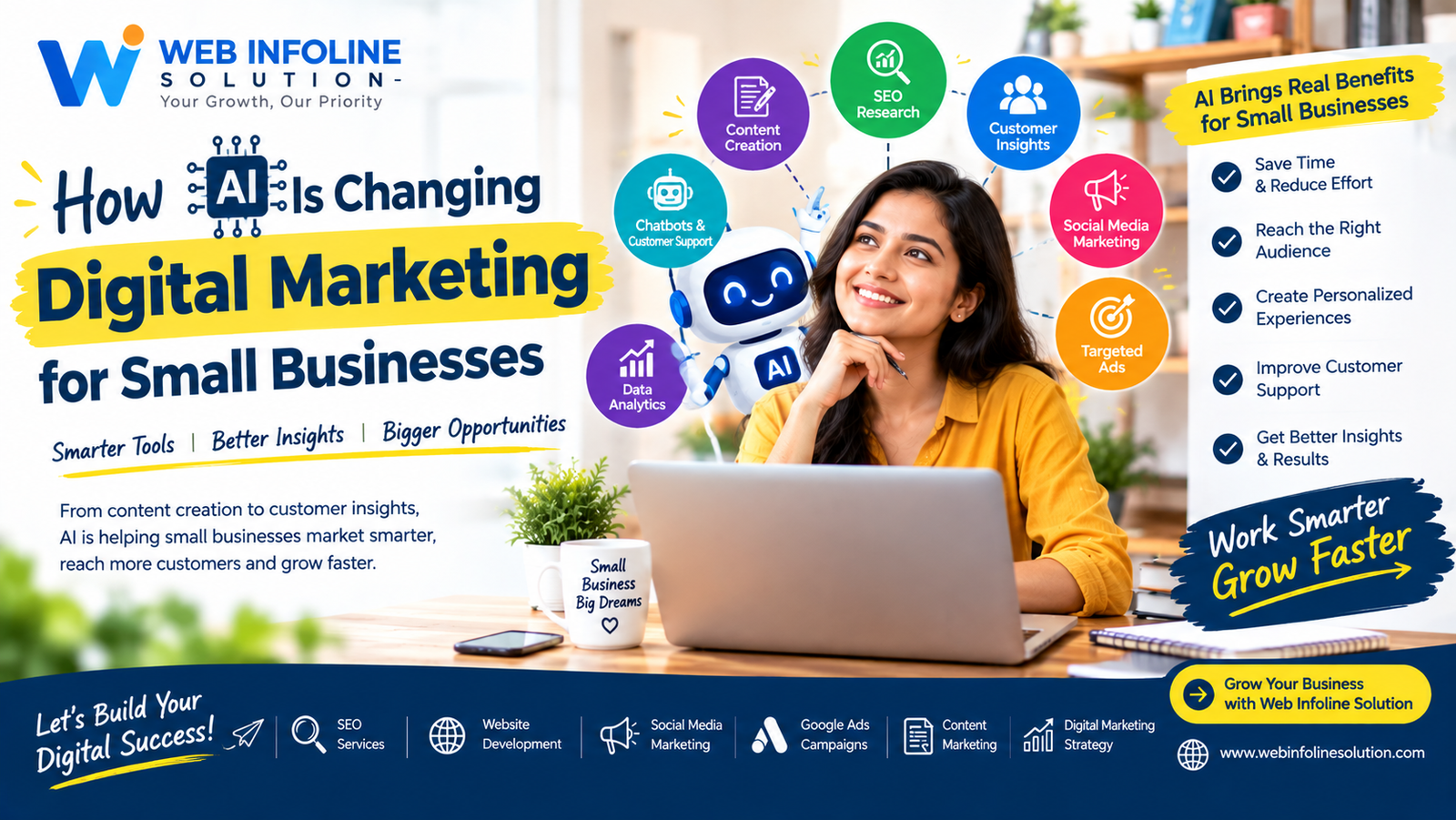
Artificial intelligence is changing the way businesses approach digital marketing. Tasks that once required hours of manual work can now be supported by AI-powered tools, helping small businesses save time, understand customers, create content, and improve their marketing processes.
For a small business owner, AI does not mean replacing the entire marketing strategy. Instead, it can be used as a practical tool to make everyday marketing faster, more organized, and more data-driven.
Creating regular content can be difficult for a small business owner who is already managing customers, employees, sales, and operations.
AI can help with:
However, AI-generated content should always be reviewed and customized. Your business experience, customer knowledge, examples, and brand personality are what make content genuinely useful.
SEO involves researching keywords, understanding search intent, analyzing competitors, creating content, and improving website pages.
AI tools can assist marketers with tasks such as identifying content opportunities, organizing keyword ideas, generating topic clusters, analyzing page structures, and creating content briefs.
For example, instead of randomly selecting keywords, a small business can use AI-assisted research to organize topics around what its potential customers are looking for.
Human review is still important because keyword relevance, business expertise, search intent, and actual customer needs should guide the final SEO strategy.
Customers do not all have the same needs.
AI can help businesses analyze customer information and create more relevant marketing experiences. For example, an e-commerce business can use customer behavior to recommend relevant products or segment audiences for different campaigns.
Better personalization can help businesses communicate with customers based on their interests rather than sending the same message to everyone.
Small businesses may not have a large customer-support team.
AI-powered chatbots and automated systems can help answer common questions about services, pricing information, business hours, appointment processes, or frequently requested information.
For more complicated questions, the conversation can be transferred to a human team member.
The goal should be to make customer communication easier—not to remove the human element from important customer interactions.
Maintaining social media consistently takes time.
AI can help marketers brainstorm:
A small business can then add its own photographs, customer stories, experience, and brand voice to make the content more authentic.
Digital advertising platforms increasingly use automation and machine learning to assist with targeting, bidding, creative testing, and campaign optimization.
Small businesses can also use AI-assisted tools to generate different ad-copy variations and analyze campaign performance.
However, businesses should still monitor advertising campaigns carefully. Automated recommendations should be reviewed against actual business goals, budget, lead quality, and conversions.
Marketing produces a large amount of data.
AI-assisted analytics can help businesses identify patterns in website traffic, customer behavior, advertising performance, and campaign results.
Instead of looking only at the number of website visitors, a business can examine questions such as:
Which channel generates enquiries?
Which campaign produces quality leads?
Which content attracts potential customers?
Which pages receive traffic but generate few enquiries?
These insights can help business owners make more informed marketing decisions.
Large companies often have dedicated marketing teams, designers, analysts, content writers, and advertising specialists.
AI tools can give small teams access to productivity support that was previously more difficult to obtain.
A small business can use AI to assist with research, content planning, customer communication, data analysis, and repetitive marketing tasks while keeping strategic decisions under human control.
AI is powerful, but it should not be treated as a complete replacement for marketing expertise.
Businesses still need people to understand:
AI can help produce information quickly, but human review is important for accuracy, originality, relevance, and brand consistency.
You do not need to adopt dozens of AI tools at once.
Start with a few practical applications:
Step 1: Use AI for content ideas and planning.
Step 2: Use AI to organize SEO research.
Step 3: Create social media content faster.
Step 4: Automate simple customer questions where appropriate.
Step 5: Analyze marketing data and campaign performance.
Step 6: Test AI-assisted advertising and creative variations.
Step 7: Review everything before publishing or sending it to customers.
Start with repetitive tasks where AI can save time, then expand your use as you understand what works for your business.
AI is becoming an increasingly useful part of the digital marketing ecosystem. For small businesses, the biggest opportunity is not simply generating more content—it is using technology to save time, understand customers, improve processes, and make better use of marketing resources.
Businesses that combine AI tools with human creativity, SEO expertise, customer understanding, and a clear marketing strategy can build a more efficient digital marketing workflow.
The key is to use AI intelligently rather than depending on it completely. Your business knowledge and understanding of your customers should remain at the center of your marketing strategy.
If you need help with AI-powered digital marketing, SEO, website development, social media marketing, Google Ads, content marketing, or online business growth, Web Infoline Solution can help you develop a practical digital strategy that combines modern technology with human expertise.